Designing the Foundations of Working Capital at BILL
Small businesses don't wake up needing a loan. They wake up needing to make payroll, pay vendors, and keep cash flowing. I helped define BILL's working capital strategy by identifying invoice financing as the first product, then designing the shared lending infrastructure that laid the foundation for a broader working capital platform.
Showing TLDR.
Outcome
0k+
Loans disbursed
$0.0B
Capital provided to SMBs
+$0M
Revenue generated
Role, scope & impact
Founding designer for BILL’s Working Capital team
Defined the working capital vision alongside product leadership
Built the lending design system in partnership with the design system team
Designed working capital for web, mobile web, iOS, and Android
Led a company-wide workstream with two other principal designers to modernize and unify the design system across BILL and the acquired startups
Prototyped future working capital concepts
Key challenges
Identifying the right product to launch
I partnered with product to evaluate lending products against user impact, business potential, and speed to market. Invoice financing combined BILL’s proprietary payment data with a simpler servicing model and gave us a faster path to lending infrastructure and a way to serve businesses that traditional lenders often overlooked.
Building into a scalable system
A key finding from my research was: Most lending experiences, especially on the servicing side can be repurposed to serve other working capital products with minimal updates and this could help bring down Engg effort and compress product launch windows. I partnered with the design system and engg leadership to start building out the lending design system components and widgets any team from BILL could use.
Hover over a graph to bring it to life. Try the page’s day and night modes.
Money on the way
$11,650.00
Expected to arrive by 11/08/2025
Spend card usage
$7,900.30
90% of budget used for this month
Cash runway
47 days
At current burn rate ($198k avg. monthly burn)
2026 Cashflow
Your business is on track to end 2026 with a positive cashflow of
$1,438,192.50
Expected cash in$1,150,000.00
Projected cash out$810,000.00
Monthly cashflow summary
$438,192.50
13% more than last month
Total Cash in$1,150,000.00
Total Cash out$810,000.00
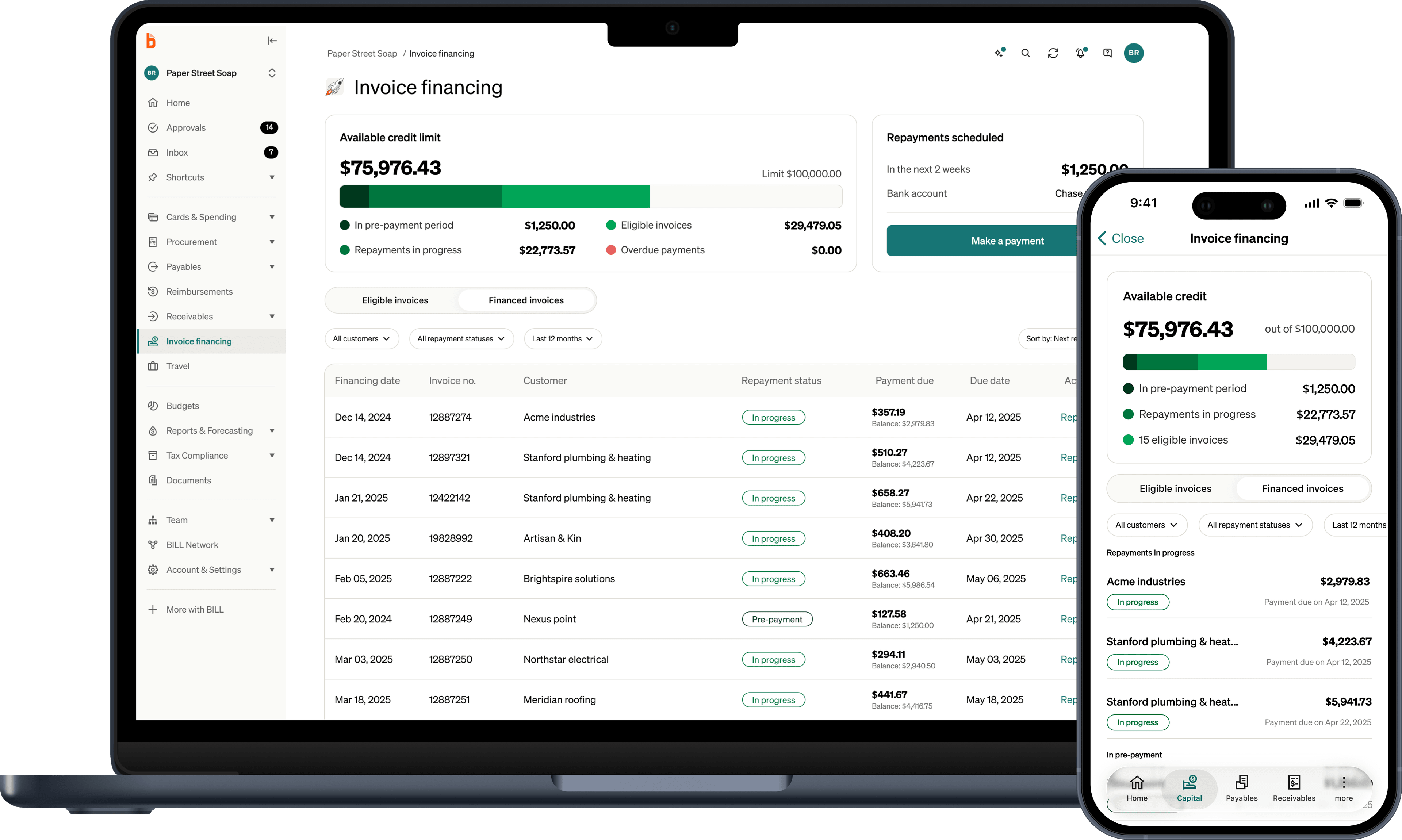
Available credit limit
$75,976.43
Limit $100,000.00
In pre-payment period$1,250.00
Eligible invoices$29,479.05
Repayments in progress$22,773.57
Overdue payments$0.00
Money out this month
$82,500.00
$7,500.00 more than last month
Through BILL
15 bills due this month$25,000.00
Spend card payment$45,000.00
Repayment on loans$7,500.00
Other accounts
Chase business loan$2,873.87
Gusto payroll$8,000.00
Connect more accounts
Pay over time
✓Stanford plumbing & heating gets paid in full
Payment will be delivered instantly
Your 4 monthly installments of $103.00 starts on May 21, 2024
Monthly installments will automatically be withdrawn from your Wells Fargo ****4653 account
Pay bill
Outstanding balance
$25,076.11
Interest8.99 APR
Bank accountChase ****2323
Loan term7 months remaining
Automatic paymentsON
Upcoming payment
$3,057.19 due on Apr 12, 2025
Make a payment
Money in this month
$72,134.11
$10,134.00 more than last month
Through BILL
4 ACH payments$60,000.00
2 Instant payments$2,134.11
Other accounts
Chase business banking..$5,090.00
Shopify sales$4,910.00
Connect more accounts
Cashflow
$1,438,192.50
13% more than last year
Expected cash in$1,150,000.00
Projected cash out$810,000.00
FORECAST
Repayments scheduled
In the next 2 weeks$1,250.00
Bank accountChase ****2323
Make a payment
Upcoming bills
$80,125.00
in the next 30 days
No.
Customer
Due date
Amount
1055
Acme industries
Aug 03, 2025
$20,000.00
1012
Globex Corporation
Aug 03, 2025
$12,000.00
891
Bright spire solution...
Aug 03, 2025
$8,750.00
View all upcoming bills
January Cash-in
$35,000.00
Business like you typically bring in $24,250.00 per month
BILL Cash account
$298,350.00
Interest earned in 2025 -$31,232.99
Move $100,000.00 into your BILL cash account and unlock 4.50% APY
Add fundsTransfer funds
Liquidity ratio
1.4x
-0.1x compared to last month
Unlock deeper insights
Connect accounts
Identifying the right entry point for IF
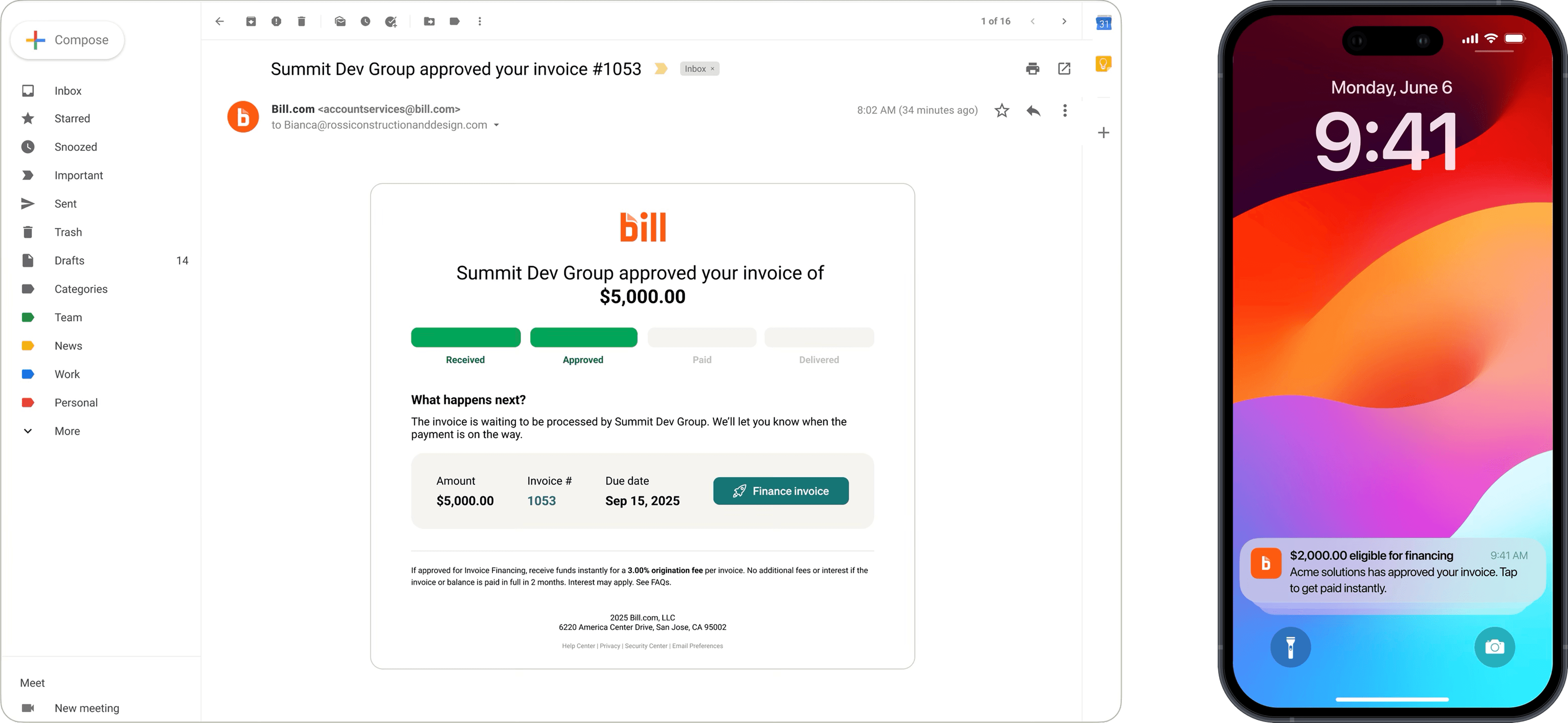
BILL is predominantly a payment platform and so our users don’t consider BILL while looking for capital. They already have a prioritized list of sources for capital. To get ahead of this cycle, I utilized the “Money on the way” email and push notification to make users aware of the Invoice Financing offer before they identified the need for capital.
Balancing usability with Compliance
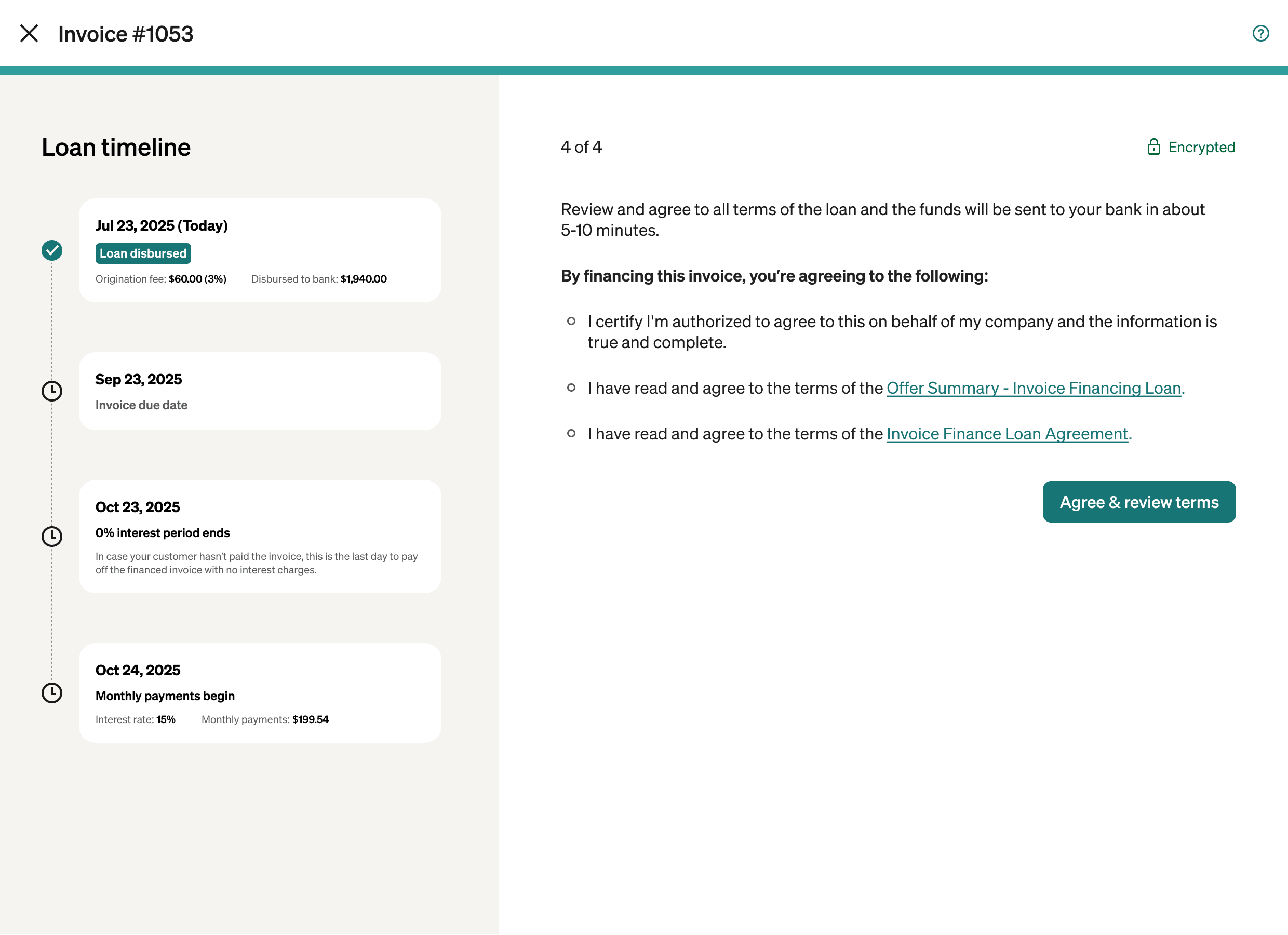
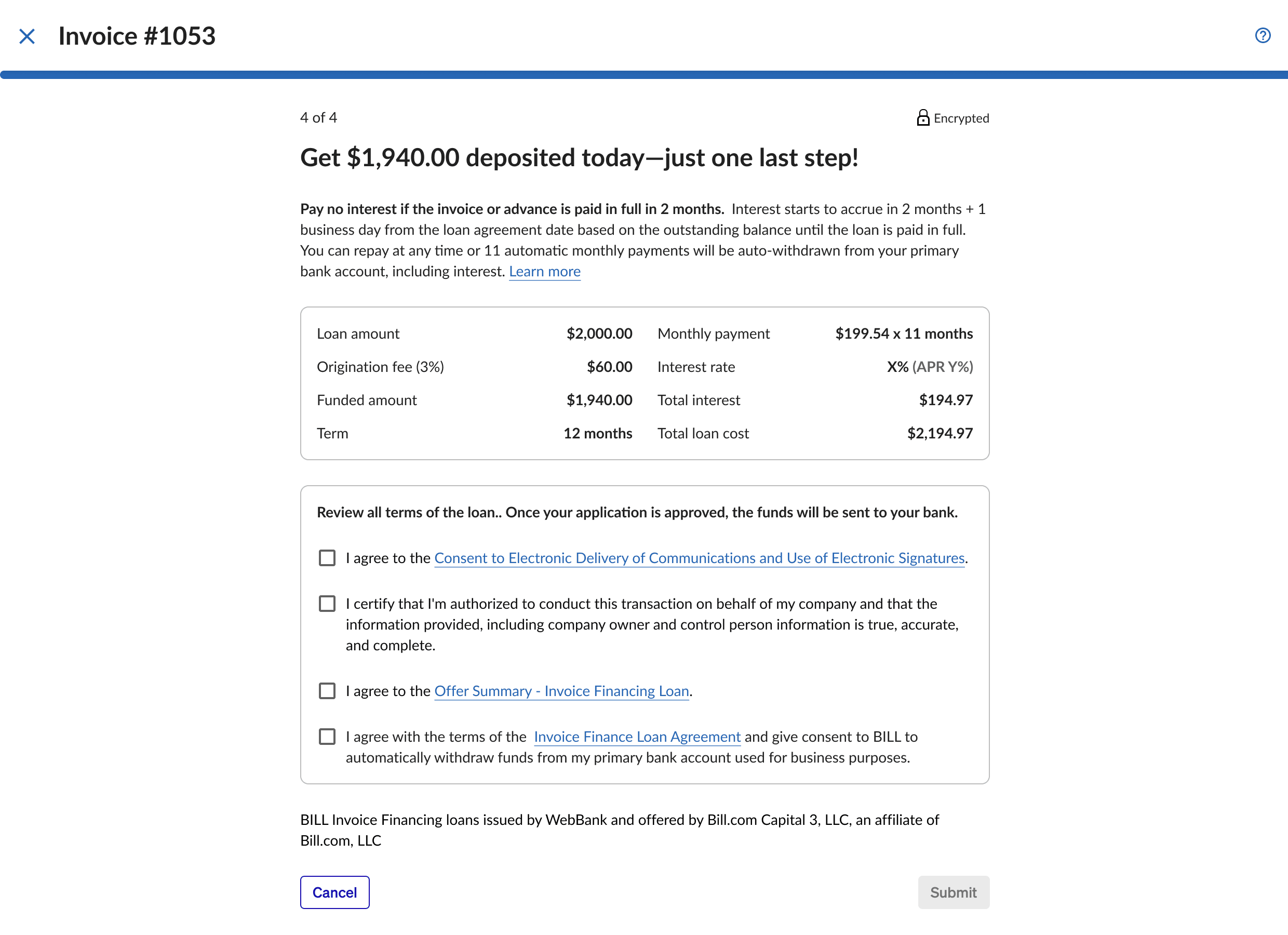
Invoice Financing relied on an external lending partner whose regulatory and compliance requirements heavily influenced the application experience. For the initial launch, we settled on a minimal application experience that would adhere strictly to the lending partner's requirements, with subsequent phases incorporating more usability enhancements.
BeforeAfter
Drag to compare the application experiences. Use the left and right arrow keys to adjust, Home to show the updated application, or End to show the original.
Access to capital in seconds
One of the key lessons I carried forward from my time on QuickBooks was that small business owners are often far more willing to manage their business from a smartphone than product teams assume. BILL largely operated through a desktop-first experience with a companion mobile app. To capitalize on the immediacy offered by the mobile channel, I designed and proposed a mobile optimized invoice financing application flow. This was rolled out first as a mobile-web based application, and later was built natively across iOS and Android OS. Since launch, more than 40% of all loans have been originated through mobile devices.
Reimagining BILL
This project revealed a larger opportunity. Businesses were not looking for financing in isolation. They were trying to manage cash flow, plan for upcoming payables, and make decisions about the future of their business.
This realization shaped my longer-term vision for working capital at BILL: integrating lending, payables, receivables, forecasting, and planning into a unified experience that helps businesses understand their options and make smarter financing decisions with confidence.
 Chase business loan$2,873.87
 Gusto payroll$8,000.00
 Shopify sales$4,910.00

 Money on the way
 January Cash-in